
 Deutsch
 English
KOH Pump for Alkaline Electrolysis | MARCH PUMPEN
Pump solution for 30% KOH at 70–90 °C and 25 bar system pressure
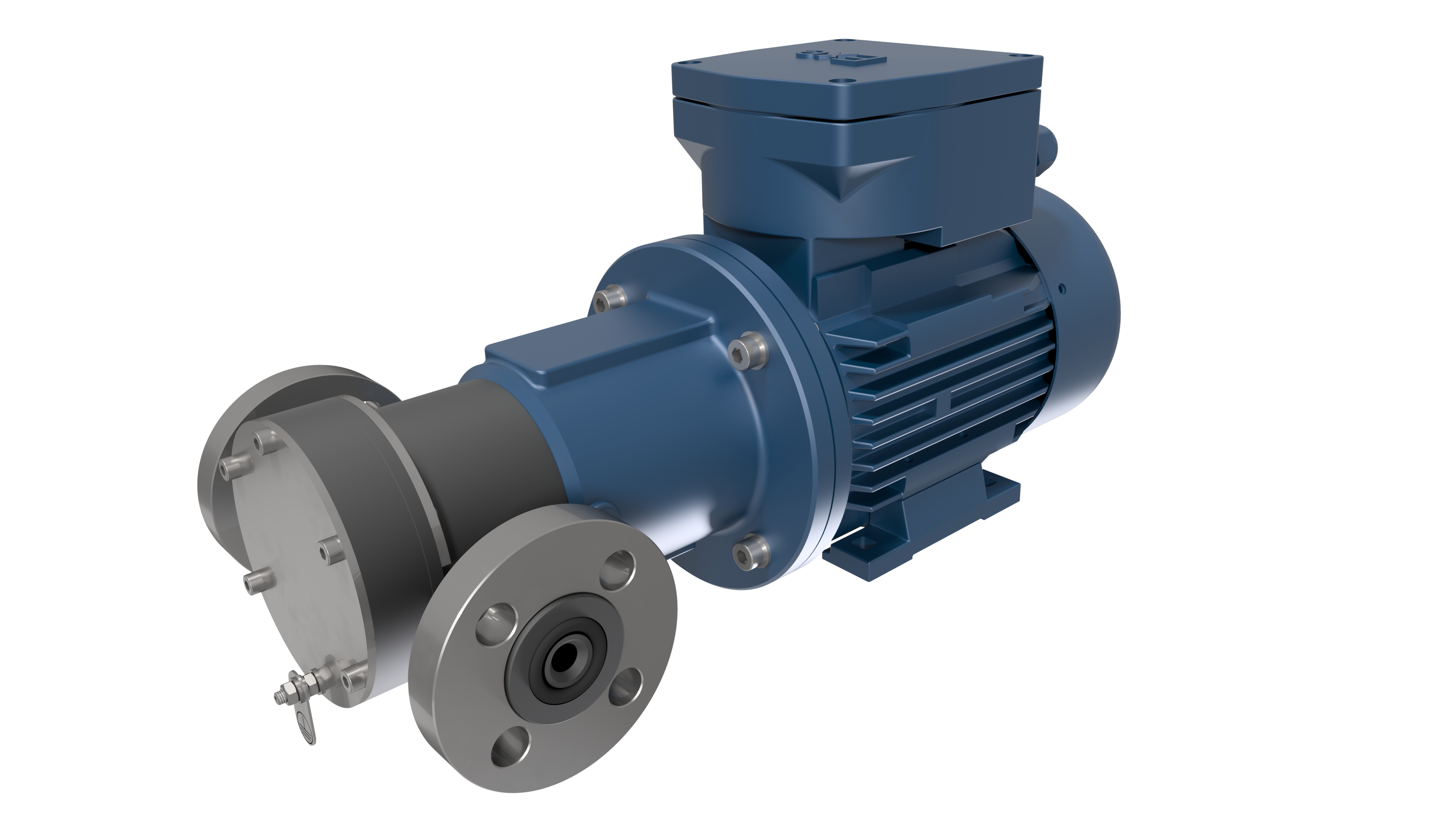
For a miniaturised high-pressure stack electrolyser, MARCH PUMPEN configured a magnetically coupled external gear pump to handle a 30% potassium hydroxide solution (KOH, caustic potash). The project-specific TEF-MAG® 201 is designed for process temperatures of 70 to 90 °C, a system pressure of 25 bar and flow rates of 20 to 250 l/h.
The wetted components are made from chemically resistant non-metallic materials, including electrically conductive PEEK, silicon carbide (SSiC), graphite and FFKM. For use in the hydrogen environment, the pump version was designed in line with the project requirements for ATEX II 2G, Zone 1.
The challenge: pumping hot caustic potash at high system pressure
In alkaline electrolysis, an aqueous potassium hydroxide solution serves as the electrolyte. In this project, the pump has to handle 30 wt.% KOH under demanding pressure and temperature conditions. A low flow rate is combined with high inlet and differential pressures.
The design also had to account for chemical resistance to hot caustic potash, non-metallic wetted components and explosion-protection requirements. The pump configuration therefore had to combine chemical and temperature resistance, pressure strength, low flow rates and the project-specific ATEX design.
Process data for the KOH application
| Medium | Potassium hydroxide solution (KOH, caustic potash) |
|---|---|
| Concentration | 30 wt.% KOH |
| Process temperature | 70–90 °C |
| Inlet pressure | 16 bar |
| Differential pressure | 9 bar |
| Pump system pressure | 25 bar |
| Flow rate | 20–250 l/h |
| Hydrostatic pressure test | 37.5 bar |
| Explosion protection | ATEX II 2G, Zone 1 |
| Operation | Frequency converter |
| Pump type | TEF-MAG® 201 |
Wetted materials of the TEF-MAG® 201
| Pump housing | Electrically conductive PEEK |
|---|---|
| Containment can | Electrically conductive PEEK |
| Pressure reinforcement of the containment can | External stainless-steel sleeve |
| Shafts | SSiC |
| Gears | PEEK-HPV |
| Gear cage | PEEK-HPV |
| Plain bearings | Graphite |
| O-rings | FFKM |
| Inner magnet | Electrically conductive PEEK |
The external stainless-steel sleeve increases the pressure resistance of the containment can but does not come into contact with the pumped medium. The wetted components therefore remain non-metallic.
The solution: magnetically coupled TEF-MAG® 201 with conductive PEEK components
The patented magnetically coupled TEF-MAG® external gear pump forms the basis of this customised solution. External gear pumps are suitable for applications that require low, defined flow rates against comparatively high differential pressures. The TEF-MAG® provides low-pulsation delivery.
Power is transmitted through a magnetic coupling, so the pump does not require a dynamic shaft seal between the pump chamber and the surrounding environment. This eliminates a typical potential leakage point by design – an important advantage when handling aggressive or safety-critical media.
The required combination of chemical resistance, mechanical strength, temperature and pressure resistance, and the electrical requirements of the project-specific ATEX design called for a special material. Working with a material manufacturer, MARCH PUMPEN selected an electrically conductive PEEK grade for the application.
Why use a gear pump for KOH in alkaline electrolysis?
The combination of a low flow rate and a high differential pressure places particular demands on the pump technology. In this electrolysis project, the pump has to deliver 20 to 250 l/h while handling an inlet pressure of 16 bar and a differential pressure of 9 bar. This results in a pump system pressure of 25 bar.
For this application, the TEF-MAG® 201 combines several key features:
- handling of 30 wt.% KOH at 70–90 °C
- low flow rates of 20–250 l/h
- operation against a differential pressure of 9 bar at a system pressure of 25 bar
- low-pulsation delivery
- magnetically coupled, sealless design
- chemically resistant, non-metallic wetted materials
- electrically conductive PEEK for the project-specific design
- ATEX II 2G design for use in Zone 1
- flow adjustment using a frequency converter
What is the function of KOH in alkaline electrolysis?
In alkaline water electrolysis, electrical energy is supplied to split water into hydrogen and oxygen. An aqueous potassium hydroxide solution serves as the alkaline electrolyte and enables ion transport between the electrodes.
At the negatively charged cathode, water is reduced to form hydrogen and hydroxide ions (OH−). The hydroxide ions move through the alkaline electrolyte and separator towards the positively charged anode, where they are oxidised and oxygen is formed.
Overall reaction: 2 H2O → 2 H2 + O2
A separator or diaphragm separates the electrode compartments and reduces mixing of the hydrogen and oxygen product gases formed at the cathode and anode. KOH serves as the electrolyte and is not consumed in the net reaction. In the high-pressure electrolyser described here, the potassium hydroxide solution has a concentration of 30 wt.%.
When the electrolyser is powered with electricity from renewable sources, the hydrogen produced can be classified as renewable or green hydrogen.
Why are the materials of the KOH pump so important?
Concentrated caustic potash at elevated temperatures places high demands on pump materials. This project also required the design to account for pressure loads, explosion protection and non-metallic wetted components.
The suitability of a material always depends on the specific combination of medium, concentration, temperature, pressure, mechanical load and system requirements. A general distinction between unsuitable metals and suitable plastics would not be technically accurate.
A project-specific combination of materials was therefore selected. The pump housing and other key components of the TEF-MAG® 201 are made from electrically conductive PEEK. The design also incorporates components made from SSiC, PEEK-HPV, graphite and FFKM.
Why is electrically conductive PEEK used?
PEEK combines high mechanical strength, temperature resistance and chemical resistance. This pump application also required controlled electrical conductivity. Working with a material manufacturer, MARCH PUMPEN therefore selected an electrically conductive PEEK grade.
This made it possible to create a pump version with non-metallic wetted components that is also tailored to the mechanical, thermal and electrical requirements of the project. The application demonstrates that chemical resistance alone does not determine material selection in demanding hydrogen and electrolysis systems. Pressure, temperature, explosion protection and mechanical loads must be considered together.
Result: a customised pump solution for the high-pressure electrolyser
The TEF-MAG® 201 was configured for the specific requirements of the miniaturised high-pressure stack electrolyser. The solution combines the handling of 30 wt.% KOH at 70 to 90 °C with a system pressure of 25 bar and low flow rates ranging from 20 to 250 l/h.
The magnetic coupling, pumping principle, electrically conductive PEEK materials and design for ATEX Zone 1 were tailored to the project requirements. The project demonstrates that a suitable pump solution for alkaline electrolysis depends on the interaction between the pumping principle, material selection, pressure resistance, temperature resistance and explosion protection.
Frequently asked questions about KOH pumps for alkaline electrolysis
Which pump is suitable for KOH in alkaline electrolysis?
Pump selection depends on the KOH concentration, temperature, flow rate, inlet and differential pressures, and the requirements for materials and explosion protection. In the application described here, a magnetically coupled TEF-MAG® 201 external gear pump is used for 30 wt.% KOH at 70–90 °C and a system pressure of 25 bar.
Which materials come into contact with the 30% potassium hydroxide solution?
In this application, the wetted components include electrically conductive PEEK, PEEK-HPV, SSiC, graphite and FFKM. Material suitability must always be assessed against the concentration, temperature, pressure and other operating conditions of the specific application.
Why is a magnetically coupled pump used?
A magnetic coupling transmits power to the pump internals without a drive shaft passing through the pump housing and requiring a dynamic shaft seal. This eliminates a potential leakage point by design, which is particularly valuable when handling aggressive or safety-critical media.
What flow rate does the KOH pump deliver?
In this application, the TEF-MAG® 201 is designed for a flow rate of 20 to 250 l/h. Operation using a frequency converter allows the flow to be adjusted within the specified operating range.
What pressure is the pump designed for?
The inlet pressure in this application is 16 bar and the differential pressure is 9 bar, resulting in a pump system pressure of 25 bar. The hydrostatic pressure test is performed at 37.5 bar.
Can the pump be used in an ATEX hazardous area?
The project-specific pump version described here was designed for ATEX II 2G and use in Zone 1. For other applications, the required design must be assessed against the relevant zone and operating conditions.
Other suitable pump types
The appropriate pump for an electrolysis or hydrogen application depends on the pumped medium, concentration, flow rate, pressure, temperature, material requirements and system design. Depending on the process conditions, other MARCH PUMPEN series may be considered in addition to the TEF-MAG®:
Pump selection for alkaline electrolysis and KOH applications
Are you planning an electrolyser or a comparable system and looking for a pump for potassium hydroxide, caustic potash or another demanding process medium? MARCH PUMPEN can assist with selecting and customising the appropriate pump technology.
Please provide the relevant process data: pumped medium and concentration, operating and maximum temperature, flow rate, inlet and outlet pressures, material requirements and the required ATEX zone. Based on this information, we can assess the appropriate pump and material configuration for your application.